Improves weak ground
Stabilisation increases strength, improves workability and raises bearing capacity, helping problematic soils perform as part of the engineered foundation build-up.

Ground Stabilisation UK
We design and deliver ground stabilisation solutions that improve bearing capacity, reduce excavation, minimise imported aggregate and create durable working platforms, capping layers and sub-base for infrastructure and development projects across the UK.
Ground stabilisation is the process of improving in-situ or site-won soils so they can perform as a dependable engineered layer. By using carefully selected binders such as lime, cement or other cementitious materials, unsuitable ground can often be modified, strengthened and compacted for use beneath roads, platforms, compounds and building areas.
Instead of removing large volumes of weak material and replacing it with imported stone, stabilisation makes better use of the ground already on site. The result is a more efficient, more sustainable and often more cost-effective approach to site preparation.
BS EN 16907-4:2018 3.20 provides the following definition of stabilisation: “Soil stabilisation – operation consisting in obtaining a homogeneous mixture with binder(s), and optionally with water, which properly compacted significantly changes (generally in the medium or long term) the characteristics of the soil in a way that renders it stable, particularly with respect to the action of water and frost.”
Practical engineering benefits for programme, cost, performance and sustainability
Stabilisation increases strength, improves workability and raises bearing capacity, helping problematic soils perform as part of the engineered foundation build-up.
Re-using site-won material can significantly reduce excavation, disposal and imported aggregate demand, simplifying logistics and lowering project costs.
On suitable projects, stabilisation can shorten programme durations by removing the need for extensive dig-out and replacement. For haul roads and compounds, programme savings can be substantial.
Fewer lorry movements, less imported stone and greater use of in-situ material can deliver meaningful carbon savings compared with traditional aggregate replacement methods.
Lime modification can help dry wet cohesive soils and improve handling, allowing works to proceed more effectively in challenging ground and seasonal conditions.
Properly designed and compacted stabilised layers offer low compressibility, minimal long-term deformation and reliable support for permanent construction.
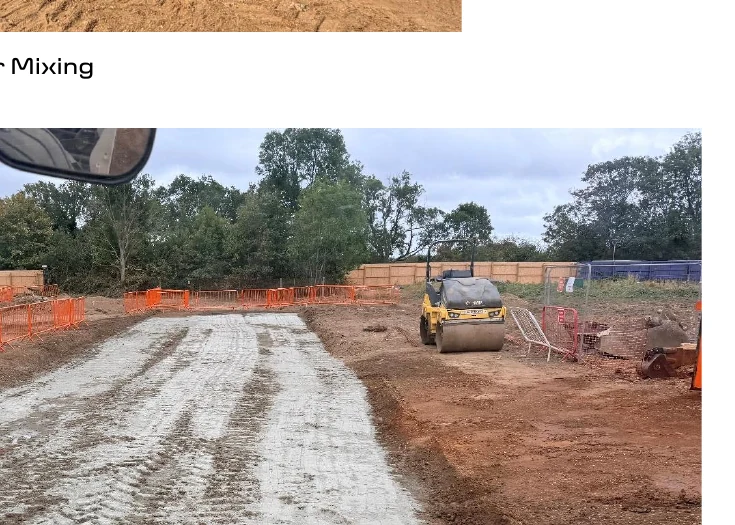
Recent site photos showing stabilisation, binder spreading, mixing, compaction and validation testing.
Short clips from recent stabilisation works on site
Testing-led design followed by controlled site delivery
We assess available site investigation data, ground conditions, sulphate testing, levels, moisture condition and bearing requirements for the intended development.
Samples are tested to identify suitability, soaked CBR performance and the optimum binder type and binder addition for the project.
A project-specific treatment plan is prepared, setting out methodology, spread rates, test schedules, compliance criteria and delivery controls.
Binder is spread and mixed into the soil using specialist plant, then the material is shaped and compacted to achieve the required density and performance.
On-site testing may include CBR, LWD, MCV, pulverisation, tray weight, HSV and other inspection test plan checks to confirm the stabilised layer is compliant.
Ground stabilisation is not a one-size-fits-all process. Soil type, moisture content, plasticity, sulphates, sulphides, pyritic material and the intended use of the stabilised layer all influence the correct approach.
Successful delivery depends on proper site investigation, appropriate chemical testing and experienced engineering judgement. Where required, specifications and test schedules should align with current UK practice for the intended application.
We approach each scheme with a treatment strategy tailored to the ground, the required performance and the construction sequence.
Stabilised capping and sub-base solutions for road and infrastructure schemes where durability, stiffness and compliance matter.
Rapid construction of robust temporary roads and compounds with fewer aggregate deliveries and reduced disruption to the local road network.
Reliable, well-prepared platforms for heavy plant operations and construction sequencing on challenging sites.
Improved formation performance and reduced variability beneath development areas where stable support is essential.

Furlong Ground Stabilisation combines practical site delivery with technical understanding. We review the ground, define an appropriate treatment strategy, verify performance through testing and deliver stabilised layers that support safe, efficient construction.
Examples of how the right treatment strategy can unlock better ground performance

Piling Platforms
Design and build stabilised piling platform using site-won cut material, delivered across 10,000m2 in 2 weeks.
View Case Study
Adoptable Roads
Stabilised 300mm capping replacement layer for 1,000m2 of adoptable road, delivered in 2 days at Wilton Park, Beaconsfield.
View Case Study

Residential Development
Capping Replacement Layer to Adoptable Roads. Bulk Fill Treatment and 300mm Capping Layer Stabilisation
View Case Study

Industrial Buildings
Bulk Fill Modification and Improvement. Capping and Subbase Stabilisation
View Case Study
Common questions from contractors, developers and infrastructure teams
A soil stabilisation contractor improves in-situ or site-won soils using lime, cement or other binders so weak, wet or variable ground can perform as an engineered layer for roads, platforms, compounds and building areas.
Lime stabilisation is commonly used where suitable cohesive soils need moisture conditioning, plasticity reduction and improved workability before compaction and final treatment.
On suitable projects, ground stabilisation can reduce dig-out, disposal and imported aggregate by improving material already on site rather than replacing it with quarried stone.
Furlong GS supports ground stabilisation, soil improvement and related earthworks projects across the UK for contractors, developers and infrastructure teams.
Ground Stabilisation Contractors UK
Talk to our team about site investigation data, treatment planning, testing and delivery.